
SOIL & PLANT MONITORING
UNDERSTAND YOUR SOIL.READ YOUR CROP.
Connect soil moisture and irrigation response with local weather and plant health observations. Give growers and agronomy teams clearer context for decisions in the field.
Discuss your monitoring needs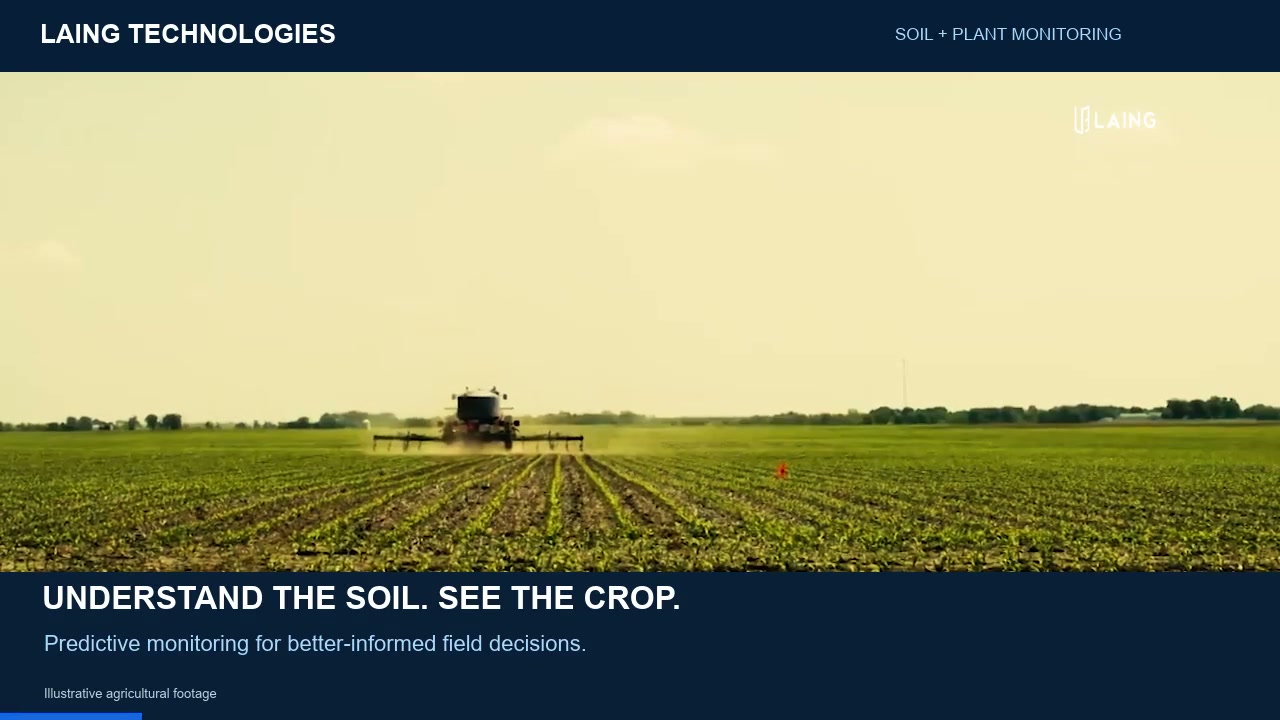 Illustrative agricultural footage and explanatory diagrams
Build the picture, from the soil up.
Define a monitoring plan around the farm’s soils, crop stages and irrigation decisions. Each phase adds context; predictive models develop as reliable seasonal data accumulates.
- 01
Soil baseline & irrigation response
Measure at appropriate depths and across representative zones. Review water retention, drainage and root-zone response after irrigation.
- 02
Weather & environmental context
Bring rainfall, local conditions and evapotranspiration into the interpretation of soil behavior and crop water demand.
- 03
Plant health & aerial observations
Use suitable crop imagery and field observations to assess vigor and emerging stress. Correlate findings with soil and weather before planning targeted scouting.
- 04
Predictive decision support
Develop site-calibrated models and alerts as seasonal history builds. Validate against field observations and communicate the confidence behind each finding.
Understand the soil.
See the crop.
English narration · English, Spanish and German captions · 2:43
English narration · English, Spanish and German captions
Illustrative agricultural footage and explanatory diagrams
Read the narration
Every field tells a different story. Soil, water, weather and plant response all matter. At Laing Technologies, our agricultural predictive monitoring approach connects these signals to support better informed decisions throughout the growing season.
Start below the surface. Understand differences between soil zones, and measure moisture at appropriate depths. Follow what happens after irrigation: where water is retained, where drainage is slow, and where the root zone may need closer attention.
Then add the environmental context. Rainfall, local weather and evapotranspiration help explain changing water demand. Bringing these observations together supports irrigation planning around actual field conditions and the crop's stage of development.
Look at how the plants respond. Where suitable imagery is available, crop vigor and emerging stress patterns can help identify areas for targeted scouting. Interpret those patterns alongside soil and weather information, rather than relying on an image alone.
The value comes from connecting the signals. A crop response may need an irrigation adjustment, a closer soil review, or a field inspection. The system supports the grower and agronomy team with context for deciding what to check next.
Predictive insight develops as reliable seasonal history builds. Models and alerts must be calibrated to the site, checked against field observations, and presented with appropriate confidence. The aim is to support earlier action as conditions change.
Begin with a defined pilot. Agree the soil zones, measurements, connectivity and decisions the information should support. Installation, calibration, training and ongoing review form part of a practical deployment plan tailored to the farm.
For cooperatives, the approach can expand from a pilot to additional farms. Shared information and consistent review methods help teams work together, while sensor coverage and the deployment scope remain specific to each farm's soil variability and needs.
Tell us about your soil, crops and irrigation challenges. Let's define a practical first step for soil and plant monitoring. Laing Technologies. Engineering, monitoring and decision support, built around your operation.
Start with a pilot. Build a basis for expansion.
Agree the field zones, measurements, connectivity and review process. A defined pilot brings installation, calibration, training and agronomic interpretation into one practical deployment plan. Cooperative expansion can share the information framework while adapting sensor coverage to each farm.
Monitoring scope, sensor density and predictive functions are defined for the site. Findings support growers and agronomy teams; they are not guarantees of yield or savings.
LAING TECHNOLOGIES
What does your field need you to see?
Tell us about your soils, crops and irrigation priorities. Let’s define the next step together.